CAMERA
Existing IP camera
Outbound local connector without public exposure
CULTURAL VENUES · COMPUTER VISION · PLATFORM EXTENSION
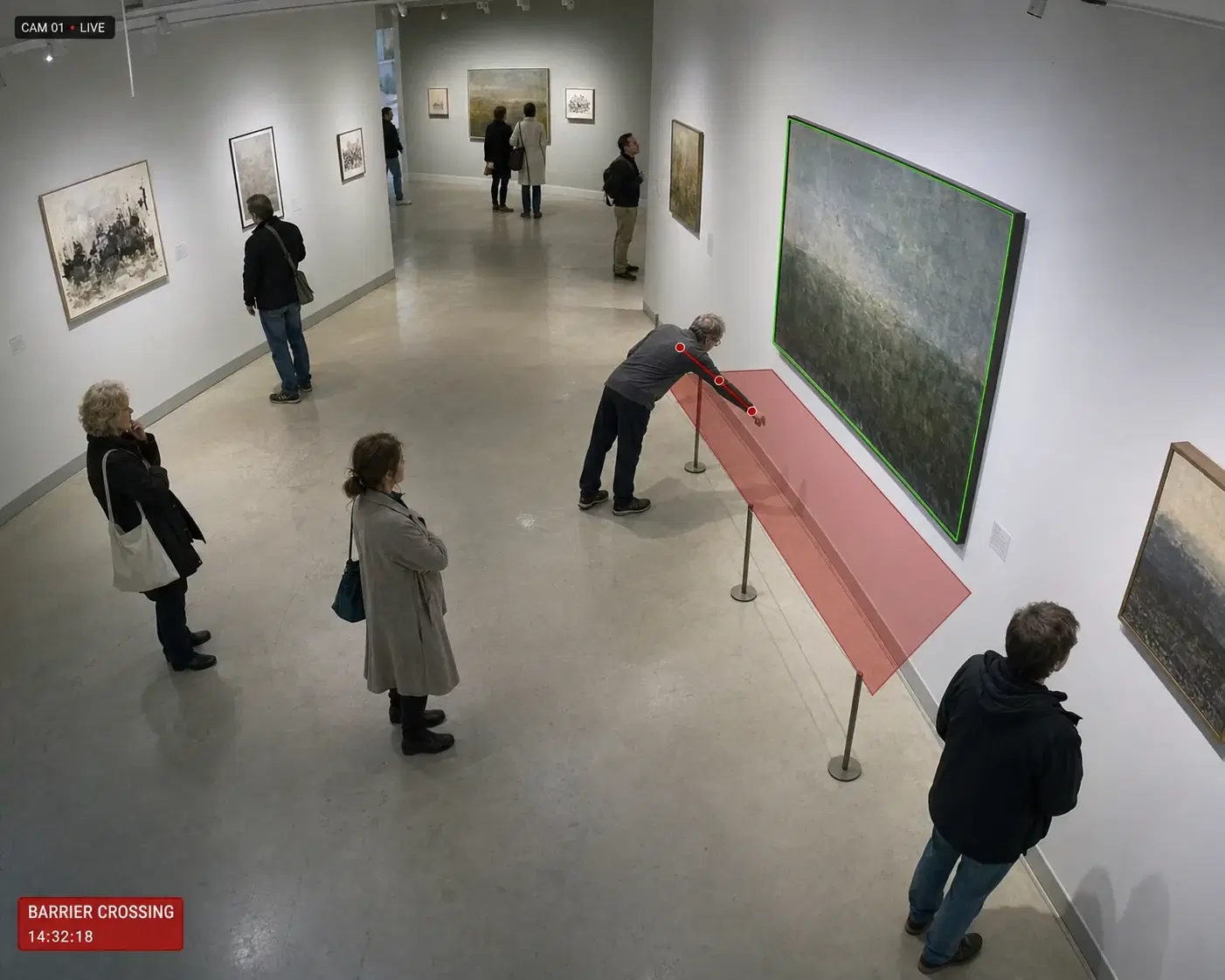
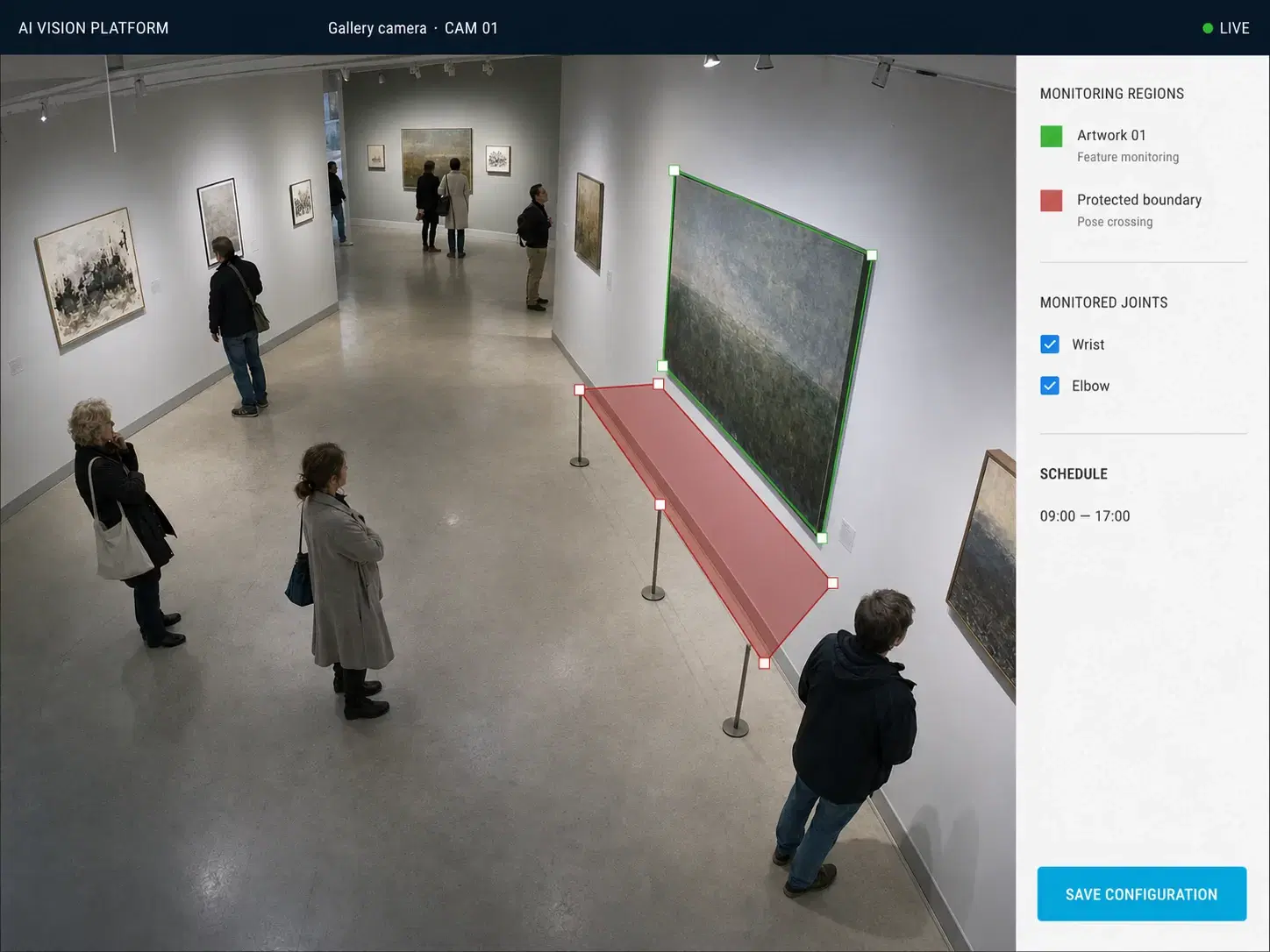
Aurrency monitored an existing IP camera for visitors leaning across a protected boundary and for material changes to an artwork, with configurable regions and timestamped visual evidence.
CAMERA
Existing IP camera
Outbound local connector without public exposure
CONFIGURATION
Configurable regions
Barrier and artwork polygons drawn in-browser
ALERTS
Evidence-first
Timestamp, type and captured image
What the POC established
THE PROBLEM AND HYPOTHESIS
A rectangular person box does not describe somebody leaning an arm across a barrier. Generic scene change does not distinguish an artwork moving from a visitor briefly standing in front of it.
The installation also needed to adapt to the actual venue. Camera angle, barrier shape, artwork position and opening hours vary. Requiring a source-code change or a newly trained model for each configuration would make a short proof of concept expensive and difficult to evaluate.
CONFIGURATION-TO-ALERT WORKFLOW
The two-week POC extended an existing platform from one outbound camera connection through configured monitoring to a reviewable alert.
01 · Test stage
Outbound camera connector
02 · Test stage
Scheduled monitoring job
03 · Human decision
User-drawn polygons
04 · Test stage
Pose and change rules
05 · Test stage
Evidence capture
06 · Human decision
Alert review
ENGINEERING DECISIONS
Camera onboarding, job lifecycle, schedules, regions, output storage and live results already existed. The project added a small set of gallery-specific processing stages and retained a clear boundary between reusable Tested Works IP and transferred client code.
Delivery model
Selected pose points and arbitrary polygons model a person leaning or reaching more accurately than a rectangular detection intersecting another rectangle.
Computer vision
VALIDATION LIMITS
The work did not establish fleet-scale performance, production security-system certification or a general alarm product. It tested one camera, two defined conditions and an evidence-led workflow on the existing platform.
RESPONSIBILITY
Two weeks · one camera · two defined security conditions
SERVICES USED
SELECTED TECHNOLOGY
RELEVANT EXPERIENCE
You need to test a camera-based operational idea without building a platform from zero.
The useful event depends on configured spatial and temporal rules around a model.
You need customer-specific logic to remain separate from reusable delivery infrastructure.
RELATED WORK
START A CONVERSATION
We can help test the rule, configuration and evidence workflow before you invest in a larger deployment.