PRODUCTION PROOF
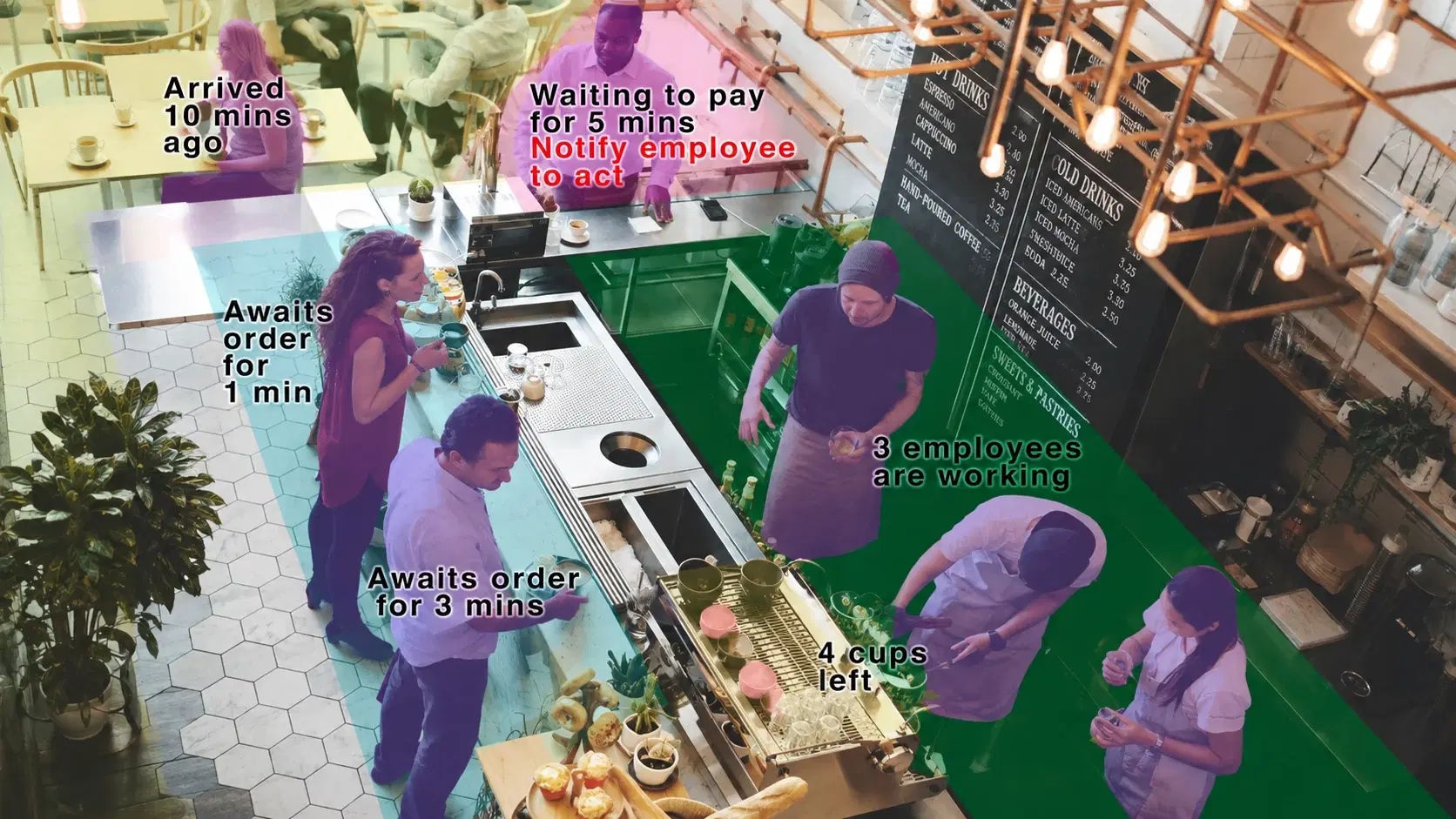
Live vision system
Deployed across UK hospitality venues.
COMPUTER VISION SYSTEMS
We build production systems that detect what is happening in images and video, turn it into meaningful events and give people the tools to review, understand and act on the result.
Operational visibility · Visual inspection · Movement analysis · Video intelligence
PRODUCTION PROOF
Live vision system
Deployed across UK hospitality venues.
SYSTEM DELIVERY
Edge + cloud delivery
Camera processing through reporting.
CLIENT FEEDBACK
5.0 on Upwork
Verified client reviews.
DELIVERY MODEL
Founder-led delivery
Direct access from scope through production.
WHERE COMPUTER VISION FITS
Computer vision is valuable when employees repeatedly watch, inspect or interpret visual activity—or when the required operating information is never recorded by existing software.
Operational visibility
Convert movement, activity and configured zones into events such as queues, service stages, dwell or exceptions.
CAMERA ACTIVITY → OPERATIONAL EVENT → REPORTING
Visual inspection and verification
Identify required objects, configured states, defects, anomalies or proof that a physical action occurred.
IMAGE OR VIDEO → VISUAL CHECK → RESULT OR REVIEW
Movement and form
Estimate pose, sequence and range of movement for coaching, rehabilitation or guided product experiences.
VIDEO → POSE + MOVEMENT → STRUCTURED FEEDBACK
Video intelligence
Track relevant activity and create events, highlights or evidence that users can inspect without watching the entire recording.
FOOTAGE → EVENT TIMELINE → REVIEW
SELECTED COMPUTER VISION EXAMPLE
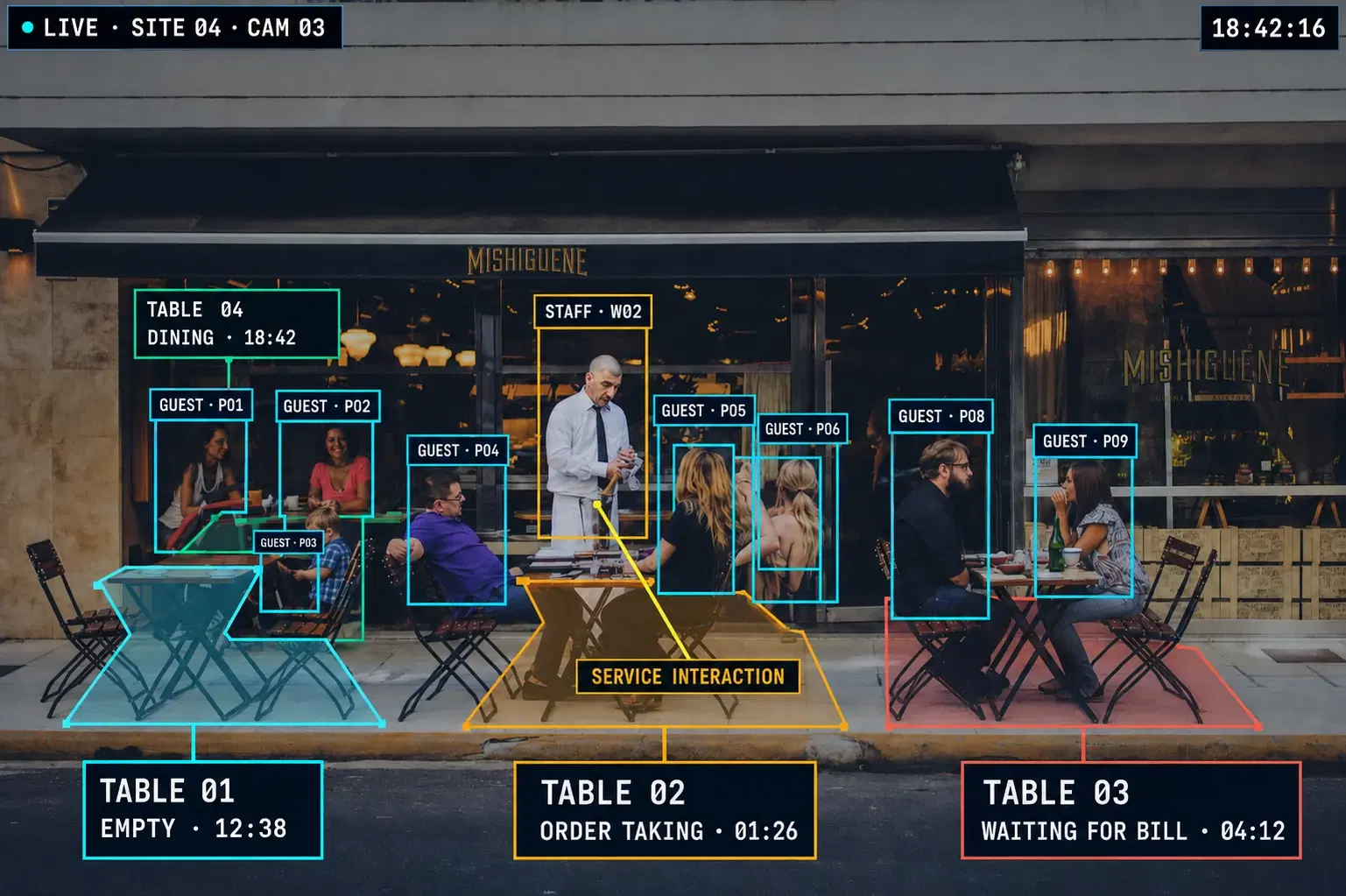
Eyezilla is included as production evidence for the complete system described on this page: capture, model behaviour, event logic, operating interfaces and recovery working together in real venues.
SUPPORTING CASE STUDY · PRODUCTION COMPUTER VISION
Important parts of restaurant operations happen physically and are not recorded by the POS or other business systems. Eyezilla converts camera streams into structured operational events and multi-site reporting.
We designed and built the complete system: camera connectivity, edge processing, detection and tracking, event logic, data pipelines, dashboards, device monitoring and production recovery.
MORE THAN A MODEL
A production vision product must reliably capture the scene, interpret it, decide what constitutes a meaningful event and expose the result inside an operable product.
Connect cameras, streams, uploaded footage or mobile capture with appropriate resolution, coverage and health monitoring.
Apply detection, segmentation, tracking or pose models evaluated against representative scenes.
Turn model outputs into persistent events using business rules, confidence, time and scene context.
Provide review, correction, analytics, alerts and integration with downstream business systems.
Device health · Model versions · Evaluation data · Access control · Evidence retention · Monitoring
PERFORMANCE IN THE REAL WORLD
A model that performs well on test footage can still fail when camera angle, lighting, crowding or operator behaviour changes.
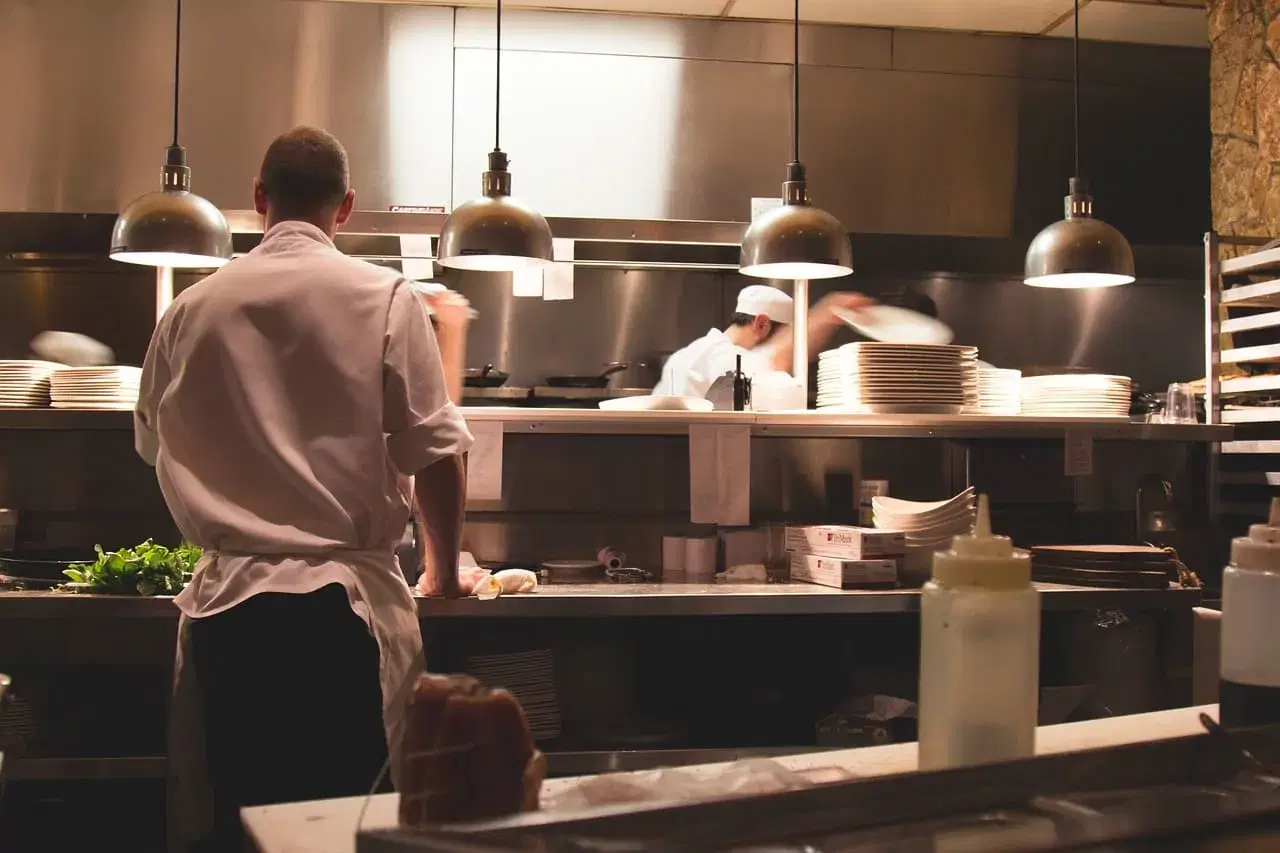
Test against footage from the environments, camera positions and conditions the system will actually encounter.
Measure missed events, false events and ambiguous cases separately rather than hiding them inside one accuracy number.
Allow permitted users to review important results and provide structured feedback.
Compare new models and event logic against the established evaluation set before deployment.
Minimise identity, footage access and retention wherever they are not required for the operating purpose.
FROM FOOTAGE TO PRODUCTION
Review representative footage, the required decision, camera setup, operating environment and acceptable failure behaviour.
FEASIBILITY FINDINGS · RECOMMENDED TEST
Test the difficult detection, tracking, pose or event logic against an agreed evaluation set.
WORKING PROOF · BASELINE RESULTS · LIMITATIONS
Deploy into one real environment to measure scene variation, hardware, connectivity and operator workload.
REAL-ENVIRONMENT PILOT · PRODUCTION RECOMMENDATION
Build the complete operating system, expand it carefully and continue measuring behaviour as conditions change.
PRODUCTION SYSTEM · MONITORING · IMPROVEMENT ROUTE
Representative footage · Required decision · Current camera setup · Operational and privacy constraints
ADDITIONAL WORK
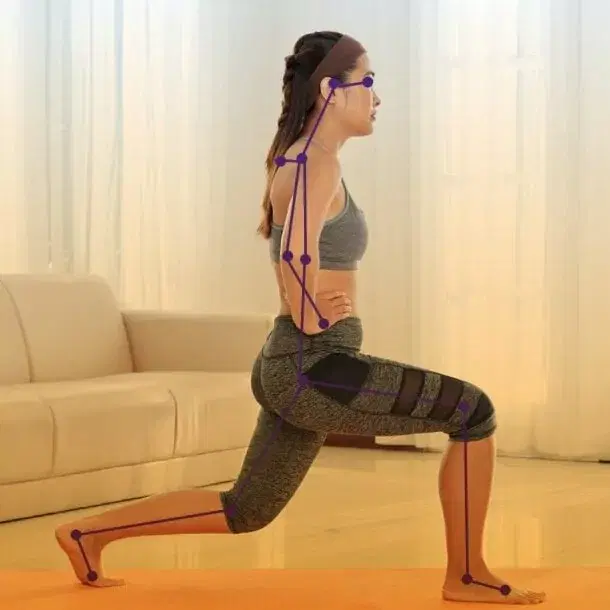
ALLIMB
Working mobile PWA with live pose analysis, repetition counting and corrective feedback.
View case study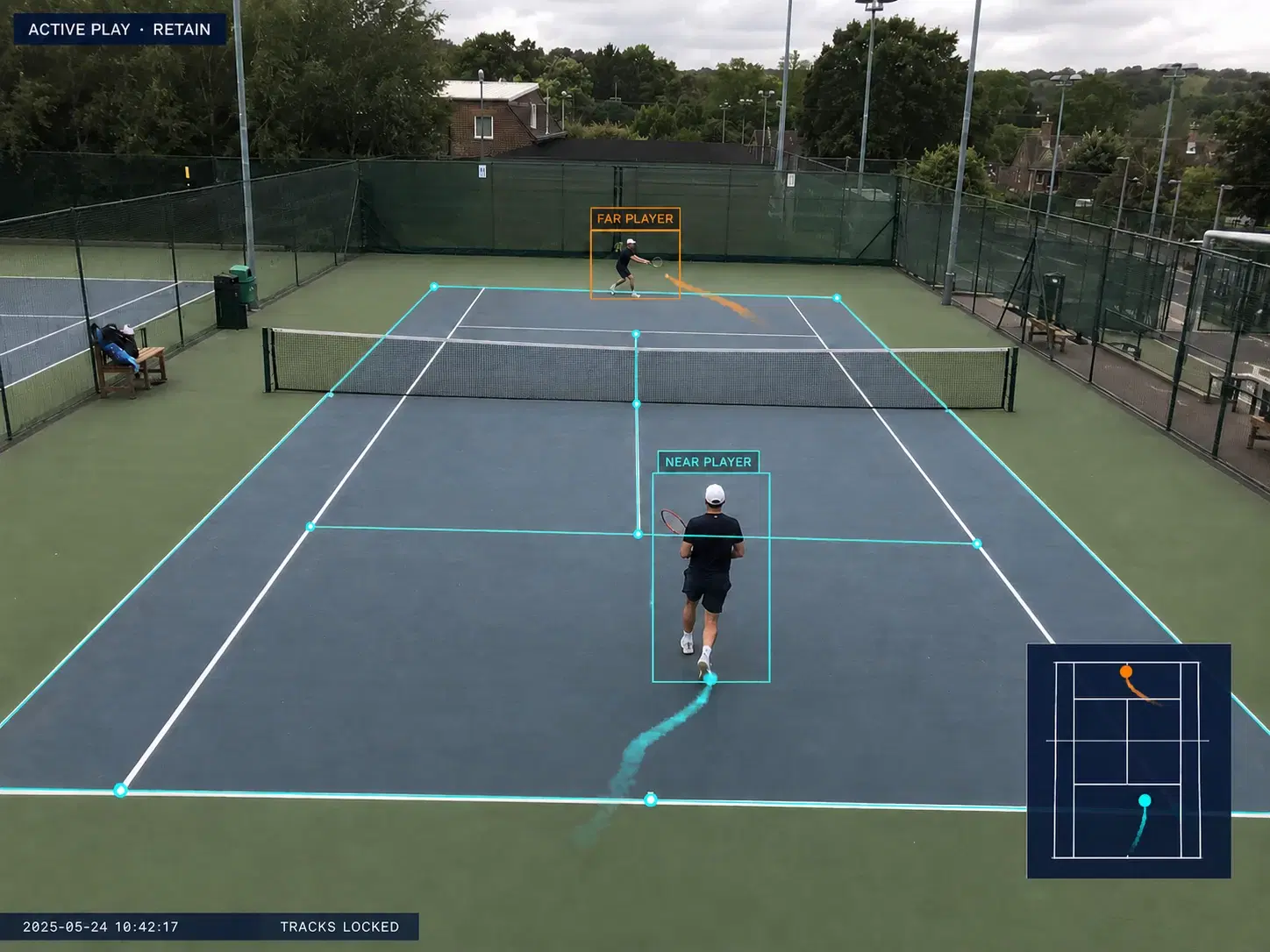
TENNIS VIDEO INTELLIGENCE
Court-aware player tracking and explainable active-play timelines.
View case studyHAVE SOMETHING SIMILAR IN MIND?
FAQ
Often, yes. Feasibility depends on stream access, resolution, frame rate, camera position, network conditions, retention rules and the decision the system must support. We assess those constraints before recommending new hardware or infrastructure.
We begin with representative footage, the required decision and explicit failure behaviour. We determine whether an existing model provides a useful baseline, what data or labelling is required and whether the complete capture-to-event workflow can satisfy the operating constraints.
We use task-specific evaluation against representative scenes and keep missed events, false events and ambiguous cases separate. Performance is reviewed across relevant lighting, camera angles, occlusion, crowding and operating states rather than reduced to one aggregate accuracy number.
Yes. Edge processing may be appropriate where latency, bandwidth, intermittent connectivity, privacy or camera access makes cloud-only processing unsuitable. A system can also combine local inference with controlled cloud event storage and reporting.
Controls are designed around the operating purpose. They can include minimising or masking identity, processing on the edge, storing events rather than continuous footage, limiting retention and restricting footage and review access to authorised roles.
PROJECT INTAKE / COMPUTER VISION
Tell us what the camera can see, what a person or system needs to know, what infrastructure already exists and which errors would matter. We will help determine whether the idea is feasible and what the first representative test should prove.
