SOURCES
Four source patterns
APIs, ODBC, browser portals and SFTP
HOSPITALITY · DATA OPERATIONS · INTEGRATIONS
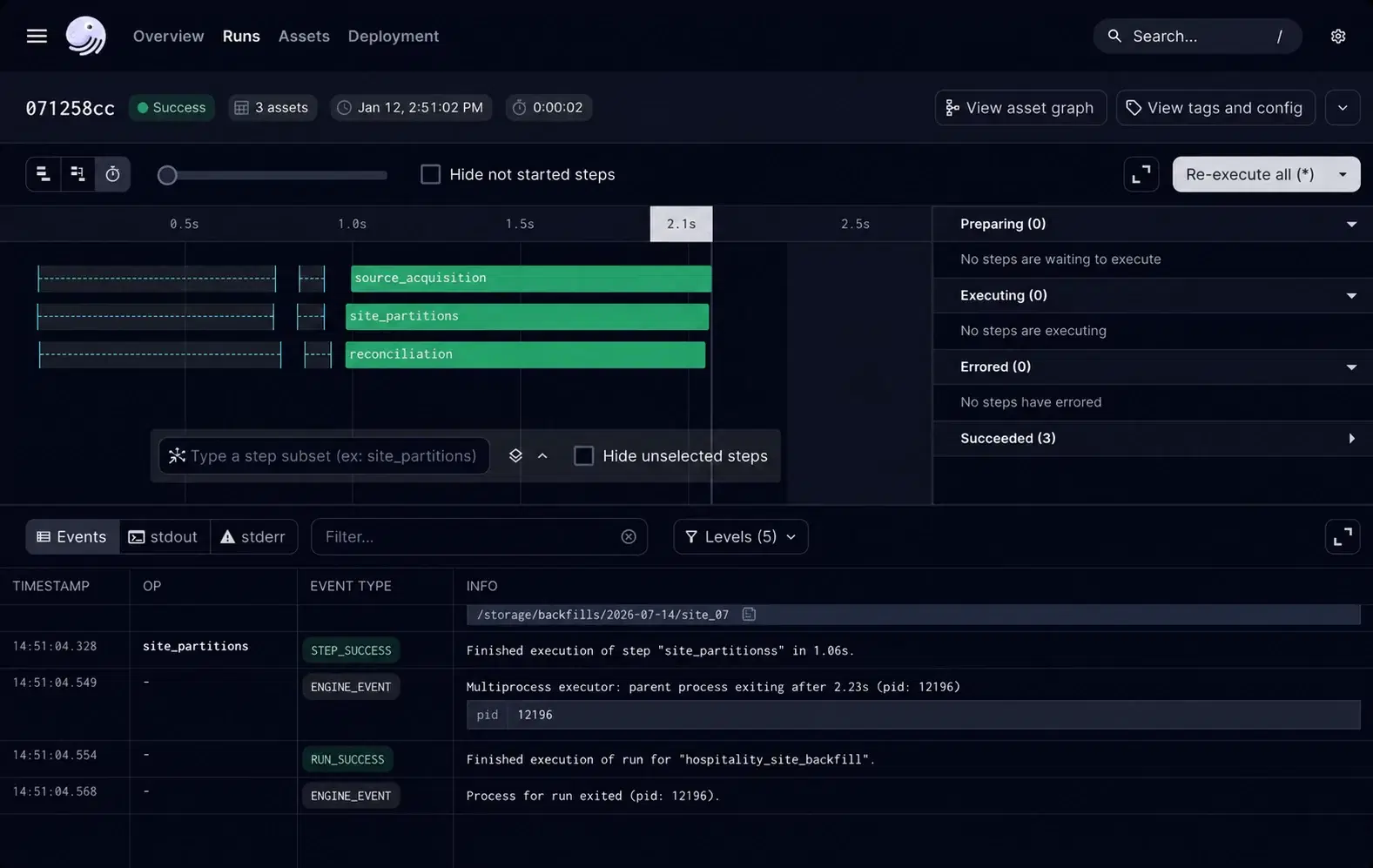
We delivered recurring data workflows across APIs, databases, SFTP and browser-only portals, while improving how the client’s Dagster platform handled partitions, backfills, concurrency, retries and reconciliation.
SOURCES
Four source patterns
APIs, ODBC, browser portals and SFTP
PROCESSING
Site-level parallelism
Controlled fan-out and fan-in
RECOVERY
Recoverable processing
Partitions, checkpoints and idempotency
PROJECT SNAPSHOT
01
Operational reporting depended on data from several suppliers, each exposing a different interface. Failures could force large re-runs, and the existing Dagster estate was not consistently using its partition, backfill and concurrency capabilities.
02
We delivered reusable acquisition and transformation components, site-level parallel processing, bounded backfills, resumable pagination, duplicate-aware finance submission and inspectable failure artefacts.
03
We owned acquisition adapters, Dagster patterns, partitioning, recovery behaviour and integration testing inside the existing estate.
What changed
They fitted straight into our weekly standups and helped migrate clients onto our new processing system. Clear, dependable code — and they even improved some of our internal algorithms along the way.
A.C.
Hospitality Software
Eyezilla operator feedback
SOURCE-TO-PLATFORM ARCHITECTURE
Retries and checkpoints form a recovery layer around site-level partitions so incomplete work can resume narrowly.
01 · System layer
Source acquisition
02 · System layer
Input validation
03 · System layer
Site preparation
04 · System layer
Partition processing
05 · System layer
Enrichment
06 · System layer
Reconciliation
SELECTED SYSTEM EVIDENCE
01
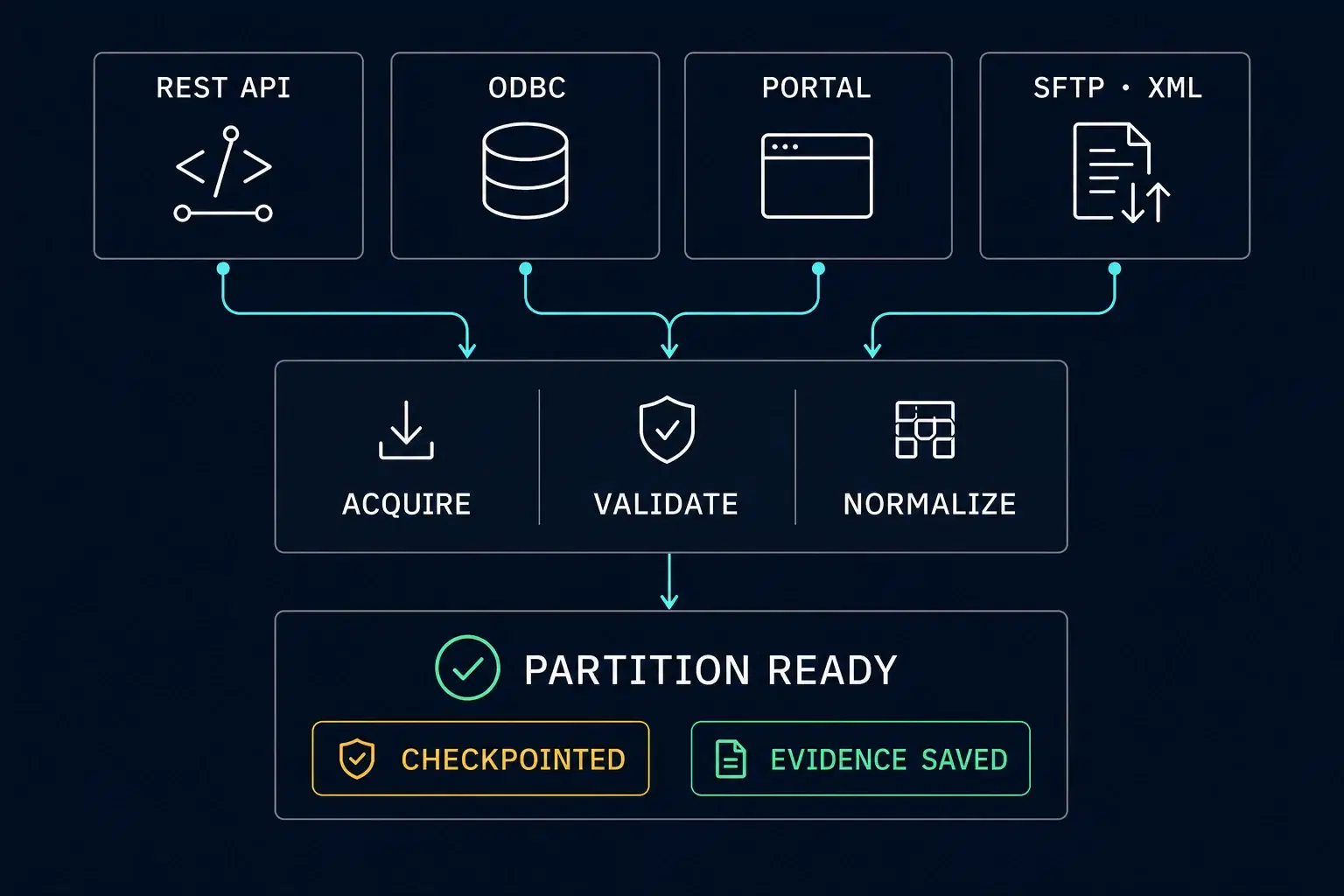
The delivered pipelines handle direct APIs, cursor- and page-based pagination, ODBC extracts, browser-only reporting and SFTP file exchange. Shared browser utilities own startup, cleanup, safe interaction, report dates, downloads and diagnostic evidence.
Why it mattered
New integrations could reuse tested operational behaviour instead of rebuilding it around every supplier.
02
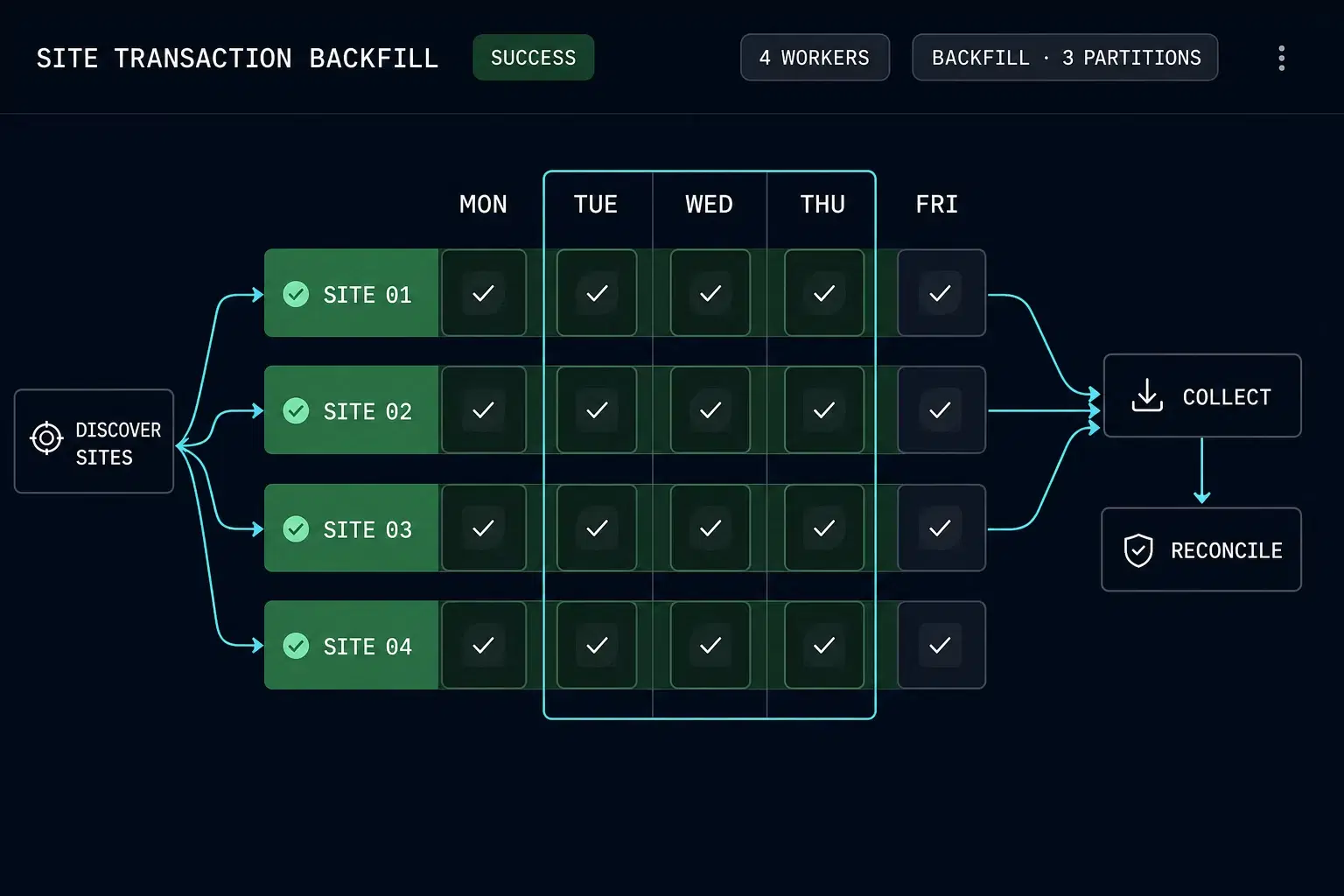
One high-frequency pipeline discovers configured sites and creates an independent processing unit for each. A custom partition IO manager preserves per-period artefacts even when several partitions are processed in a single backfill.
Why it mattered
Site-scaled workloads no longer had to extend one serial critical path, while individual periods remained rerunnable.
ENGINEERING DECISIONS
Daily and weekly partitions, London-aware schedules, UTC conversion and half-open date ranges prevent subtle duplication at day and week boundaries. Repeated intraday refreshes receive unique run keys rather than being mistaken for duplicate work.
Data correctness
Pagination state is scoped by site and business date and is retained only after the corresponding batch has been indexed. A retry resumes from the last confirmed marker rather than from the last page merely requested.
Recovery
Multi-partition runs can fetch a bounded range once and still persist one atomic artefact per asset partition. Validation checks that every requested partition produced output before the files are replaced.
Orchestration
RESPONSIBILITY
Incremental delivery within the client’s Dagster conventions
SELECTED TECHNOLOGY
RELEVANT EXPERIENCE
Your workflow depends on APIs, files, databases and browser-only systems at the same time.
Failures currently force large manual reruns or create uncertainty about what completed.
You need to improve an existing platform rather than replace it.
RELATED WORK
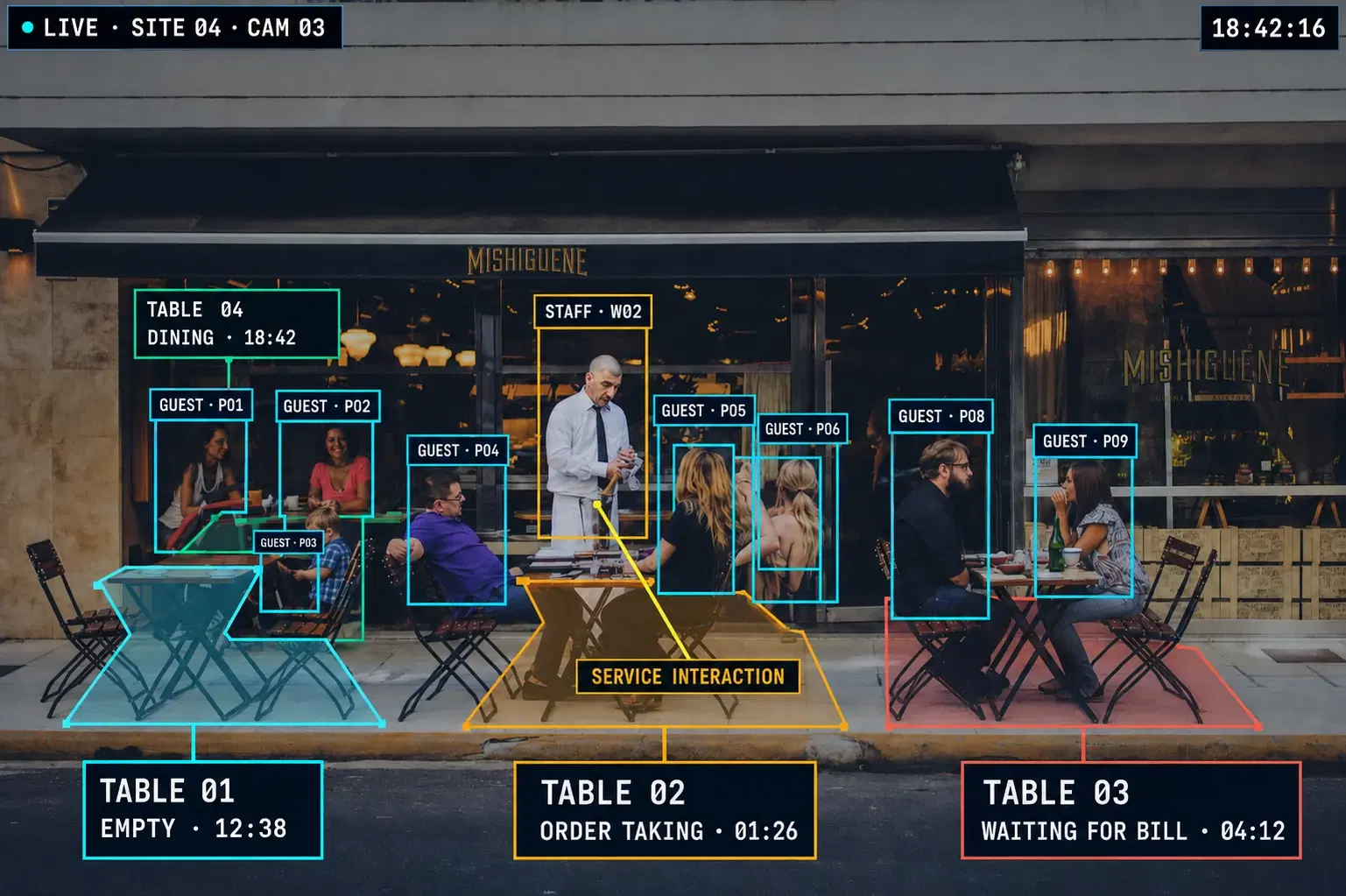
EYEZILLA
Live across multiple UK restaurant brands and venues.
View case study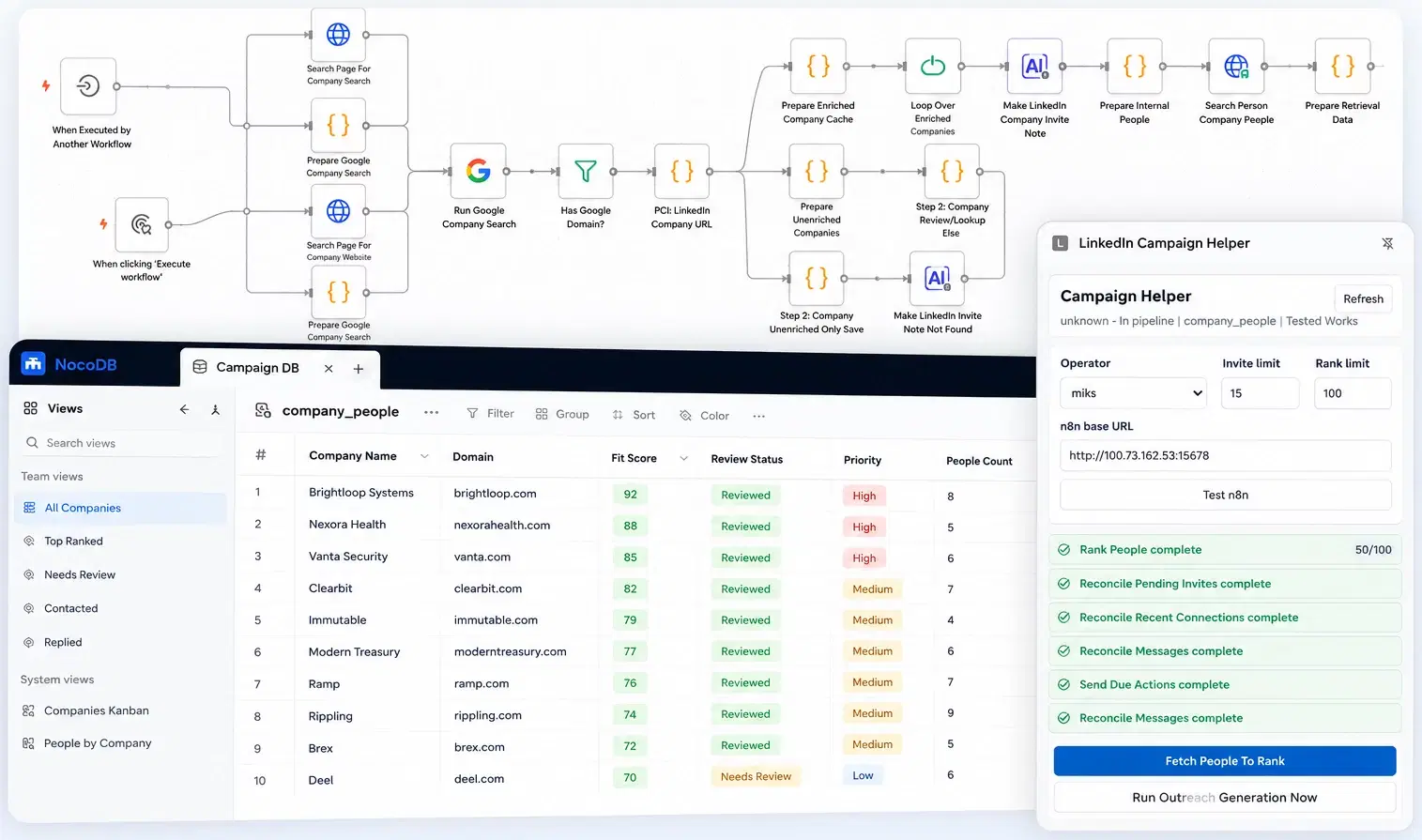
TESTED WORKS INTERNAL SYSTEM
Sixteen coordinated workflows with a shared database and operator-controlled LinkedIn actions.
View case studySTART A CONVERSATION
We can design the missing integration and reliability layer around the stack you already use.